When money gets expensive, the people with the most of it tend to buy things they can stand on. The latest read on private wealth says exactly that.
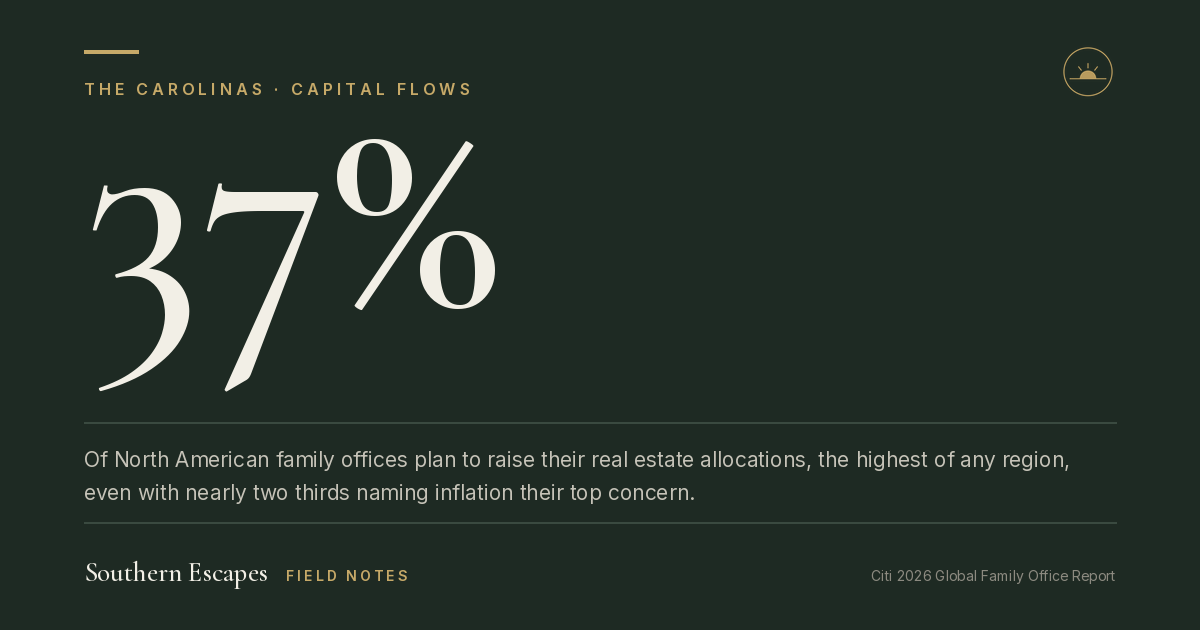
Citi's 2026 Global Family Office Report, built from 351 family offices across 41 countries surveyed in June and July 2026, found that nearly two thirds named inflation their single biggest concern, by a wide margin. Yet they are not retreating to cash. North America stood apart on one line: 37 percent of its family offices plan to increase their real estate allocations, well ahead of any other region, and North American offices already hold the highest share in direct real estate, at 13 percent against a global 10.
That is not a contradiction. It is the point. When inflation is the worry, a hard asset you can actually use starts to look like protection rather than a trophy. Christie's International Real Estate reached the same place from the buyer's side this year. Its 2026 Prime Sentiment Index named the mood among wealthy buyers in one word, belonging, and the first of its four themes was havens: homes built for resilience, protection and self-sufficiency rather than show.
The backdrop makes the move easy to read. The 10-year Treasury yield rose above 5 percent in mid-September 2026, its highest since 2007, and Freddie Mac put the average 30-year fixed mortgage at 7.40 percent in the week of October 8, 2026. Borrowing has not been this costly in years. The buyers leaning in anyway are largely the ones who do not need to borrow, and they are choosing the asset that holds its use when the dollar does not hold its value.
The Carolinas sit directly in that current. The Upstate has spent three decades building the exact thing the surveys describe, private, self-contained communities designed as their own small world. The lesson for a buyer here is not to rush. It is to behave like the family offices: treat the house as a long hold, run the carrying costs before the view wins, and buy the place that still works when rates do not cooperate.
None of this says the smart money is always right. It says the smart money is telling you what it fears and where it is putting cash to answer it. In the Carolinas, those two point at the same front door.
If a Carolinas haven is on your horizon, the advisory conversation is complimentary, and we will bring the carrying-cost math to it before the view does.
All Field Notes