A home-sale gain gets taxed twice: once by Washington, and once by the state you sell from. The federal exclusion of $250,000 single and $500,000 married carries through to the state return, because South Carolina and North Carolina both start their math from your federal income. The state only reaches the taxable slice that clears the federal exclusion. What each state does to that slice is the part of the exit math that changes at the state line.
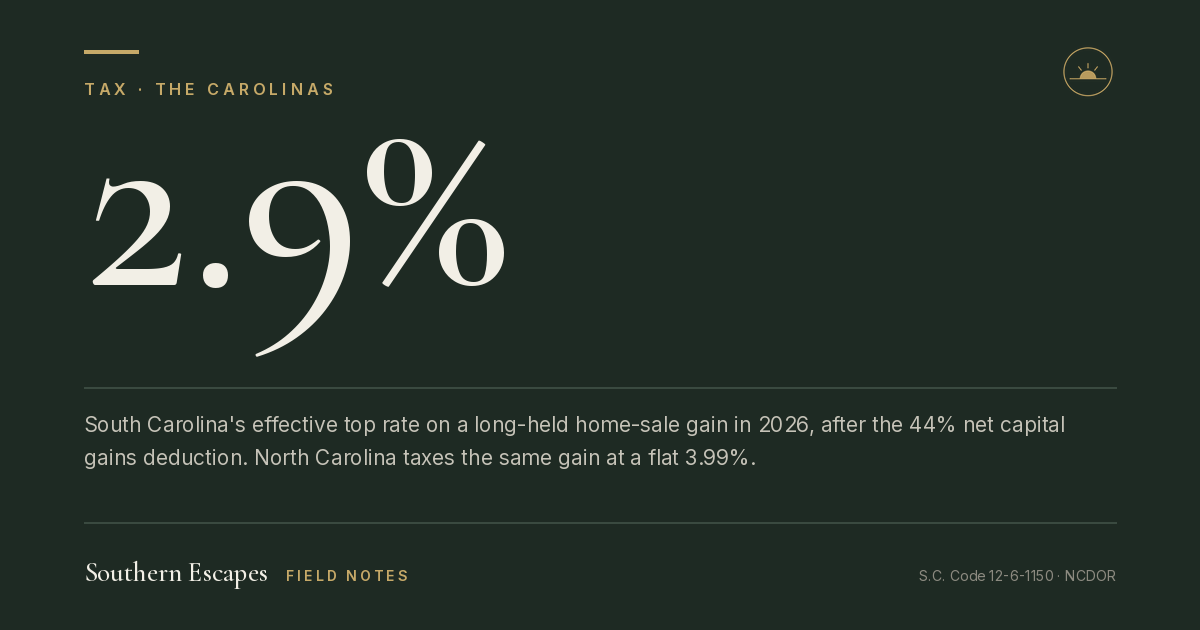
South Carolina taxes a capital gain as income, then hands most of it back. Under the income tax overhaul Governor McMaster signed in March 2026, effective this tax year, the state runs two brackets: 1.99 percent below $30,000 of taxable income and a top rate of 5.21 percent above it. Against that, Section 12-6-1150 lets an individual deduct 44 percent of a net long-term capital gain before the rate applies. Tax the remaining 56 percent at 5.21 percent and the state's effective top rate on a long-held gain lands near 2.9 percent.
North Carolina is simpler and, on a large gain, close behind. It taxes a capital gain as ordinary income at its flat 2026 rate of 3.99 percent, with no separate capital gains deduction. What you see is what you pay.
One thing the state line does not do is change the tax on the house you leave behind. A gain on real estate is generally taxed by the state where the property sits, so a seller who moves to the Carolinas and then sells a house in a high-tax state still owes that state on the gain. The Carolinas rate governs the next sale, the house you buy here, and on that one the gap against a high-tax state is the whole point.
Two cautions. South Carolina's 2026 structure is new law in its first filing season, and the capital gains deduction sits alongside other changes worth confirming for your situation. And the order of a sale and a move, including which state you are a resident of on the closing date and whether you owe a nonresident return, is its own conversation.
This is general information, not tax advice. Run your real numbers with a CPA before you list or relocate.
If you are weighing a Carolinas sale, or a move into one, and want the state tax on the gain run alongside the federal math, that conversation is complimentary.
All Field Notes