Start with the comparison nobody in South Carolina enjoys. North Carolina is a 3.99% flat state for 2026, and its 2027 rate is reported to drop to 3.49% under Session Law 2026-41, enacted July 7, 2026. South Carolina's Act 110 top rate is 5.21%, with 1.99% below $30,000 in taxable income and a $966 offset joining the two. On income tax rate alone, North Carolina wins now and, on the reported schedule, wins by more later. One caveat on that schedule: the codified statute and NCDOR both still publish the old trigger regime, so treat 2027 as likely rather than citable until they update.
Either way, any piece that leads with rate has already conceded to North Carolina. South Carolina's actual advantage sits somewhere spreadsheets rarely reach: the owner-occupied property.
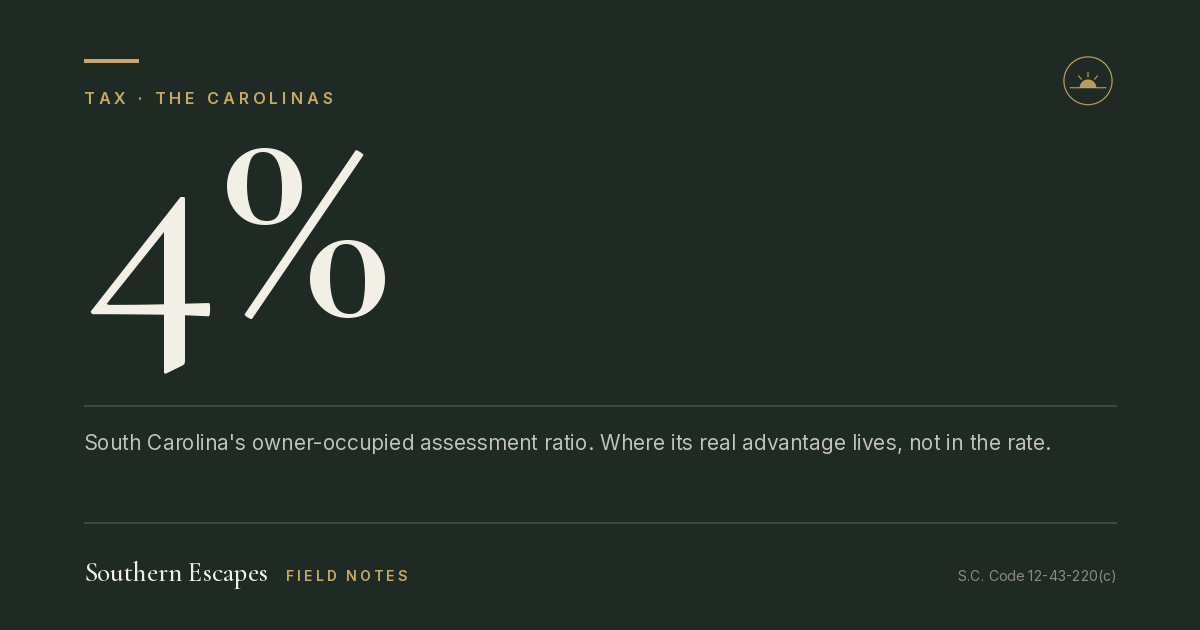
Section 12-43-220(c) assesses a legal residence at 4% of fair market value rather than the 6% ratio applied to other property. Paired with the school operating millage exemption under section 12-37-220(B)(47), which removes the single largest line on a South Carolina property tax bill, the combined effect on a high-value primary residence is substantial in a way no income tax rate table shows.
It is conditional, and the conditions are specific. The 4% ratio requires an application to the county assessor, generally before January 16. The owner must not be claiming residency benefits in another state. And renting the property more than 72 days a year forfeits the treatment. That last one has surprised more than one household with a coastal second home and an optimistic view of shoulder season.
One more South Carolina item, frequently mislabeled. The 44% deduction for net long-term capital gain under section 12-6-1150 survived Act 110 entirely untouched. Act 110 amends sections 12-6-510, 12-6-50, 12-6-1140, 12-6-1720, 12-6-3632 and 12-6-4910, and 12-6-1150 is not on that list. It is standalone law, last amended in 2000, with no sunset. It is not a transition rule. Apply 56% of income to the 5.21% rate and our arithmetic gives roughly 2.92% on a long-term gain, which is our calculation rather than a rate printed in the code.
Also worth retiring: the federal estate exemption cliff. Public Law 119-21 repealed the sunset on July 4, 2025. The basic exclusion is $15,000,000 per individual for 2026, indexed after.
If you want both states modeled against your income, your gains, and your house rather than against a headline, the Tax Alpha Calculator is the fastest start, or reply for the advisory conversation.
All Field Notes