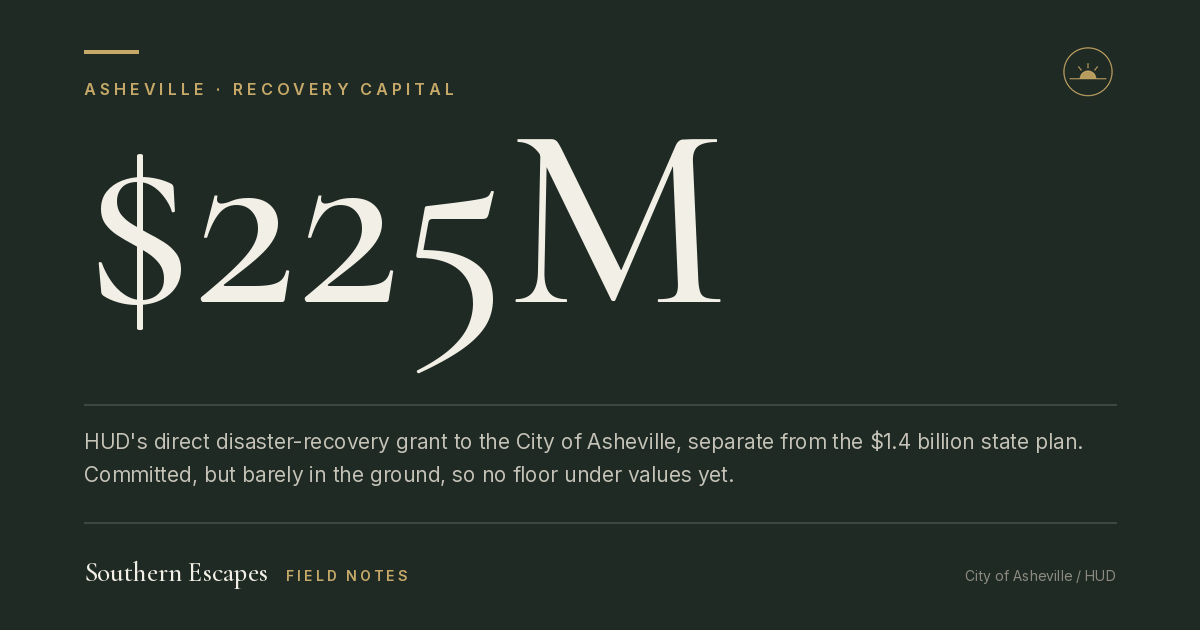
HUD sent the City of Asheville about $225 million in disaster recovery money after Helene. It is a direct allocation to the city, separate from the $1.4 billion the agency approved for North Carolina's statewide recovery in April 2025, not a slice carved out of it. Together that is more than $1.6 billion aimed at the same region. The number that matters to a buyer, though, is not the size of the grant. It is how little of it has reached a job site.
Take the piece closest to home values, single-family home repair. The city first funded that line at $3 million, enough for roughly eight houses, against a waitlist of more than a hundred qualified homeowners. As of this spring, the program had not repaired a single home. In June 2026 the City Council moved another $19.2 million into it, lifting the repair budget to $22.2 million and the estimate to 55 to 65 homes. That amendment has been submitted to HUD for final approval. It is committed on paper. It is not yet swinging hammers.
Here is why a buyer should read a housing-repair line item at all. Recovery capital, once it actually moves, becomes a floor under values. It fixes the damaged stock, it lifts the blocks around it, and it pulls in the labor and the lending that follow rebuilding money everywhere it goes. That floor has not formed in Asheville yet, because the money has not moved yet. The grant is the headline. The spending is the event, and the spending is still ahead.
So the two facts sit together. Prices have softened into year two, and the largest force that would firm them back up is approved but not yet flowing. A buyer who waits for the recovery capital to be obvious in the comps is waiting to pay for it. The wider negotiating room is available now, in the gap between the money being promised and the money being spent. That gap does not stay open once the checks clear.
If an Asheville purchase turns on the timing of the recovery, the advisory conversation is complimentary, and we will walk the funded-versus-spent picture with you.
All Field Notes