Polk County, North Carolina · The Tryon Foothills AVA
The Wine Country Nobody Told You About.
Tryon became a federal wine appellation on October 29, 2025. Four wineries, 77.7 planted acres, and a weather observation from the 1850s that explains the horses, the wine, and half the relocation conversations in this county.
Words by Damian Hall · Photographs by Stephanie Klepacki
The Shape of It
Two appellations, one escarpment
Most national coverage of western North Carolina wine points at Henderson County. That is the Crest of the Blue Ridge Henderson County AVA, effective August 2019, up around Hendersonville and Flat Rock, and it has earned the attention. Ten producers, a cider trail older than the vineyards, tasting rooms at three thousand feet.
What almost nobody has written about is that Tryon now has its own.
The Tryon Foothills AVA was published in the Federal Register on September 29, 2025 and took legal effect on October 29. It covers roughly 176 square miles, all of it inside Polk County, and it is North Carolina's seventh American Viticultural Area and the first dedicated to Polk. The petition had been in motion for the better part of twenty years.
So there are two wine regions on this escarpment, not one. They are closer than most people assume: the Crest AVA's southern boundary is the Henderson-Polk county line, and Tryon Foothills runs up to the 1,200-foot contour, so the two appellations nearly touch. What separates them is not distance. It is about 1,400 feet of elevation, and that changes everything in the glass.
The Tryon Foothills AVA, on paper
Published
September 29, 2025
Effective
October 29, 2025
Size
About 176 square miles, entirely in Polk County
Planted acreage
About 77.70 acres
Wineries
Four
Elevation
988 feet average, from 712 to 1,656 feet
Boundary
The 1,200-foot elevation contour on the west and north, the Polk-Rutherford county line on the northeast, the North Carolina-South Carolina state line on the south
Growing season
200 to 210 days
Heat accumulation
95% in Winkler Region V, 4,000 to 4,900 growing degree days
Petitioner
Cory J. Lillberg, vineyard manager, Parker-Binns Vineyard
Source: Establishment of the Tryon Foothills Viticultural Area, 90 FR 46471, September 29, 2025. On vineyard count the sources split: the federal rule says five commercial vineyards, reflecting the petition as filed, while the North Carolina Department of Agriculture said twelve in November 2025. Both agree on 77.7 acres and four wineries. We print what the rule says and tell you the state says otherwise.
Seventy-seven acres is small, and it is worth saying so before anyone else does. Napa County carries somewhere around 44,500 acres of wine grapes. Yadkin Valley, this state's own flagship, dwarfs Tryon several times over. This is not a wine region in the way the phrase lands in your ear. It is a wine region the way a seed is a tree.
What it is instead is early, permanent, and federally documented. Those three things together are rarer than scale.
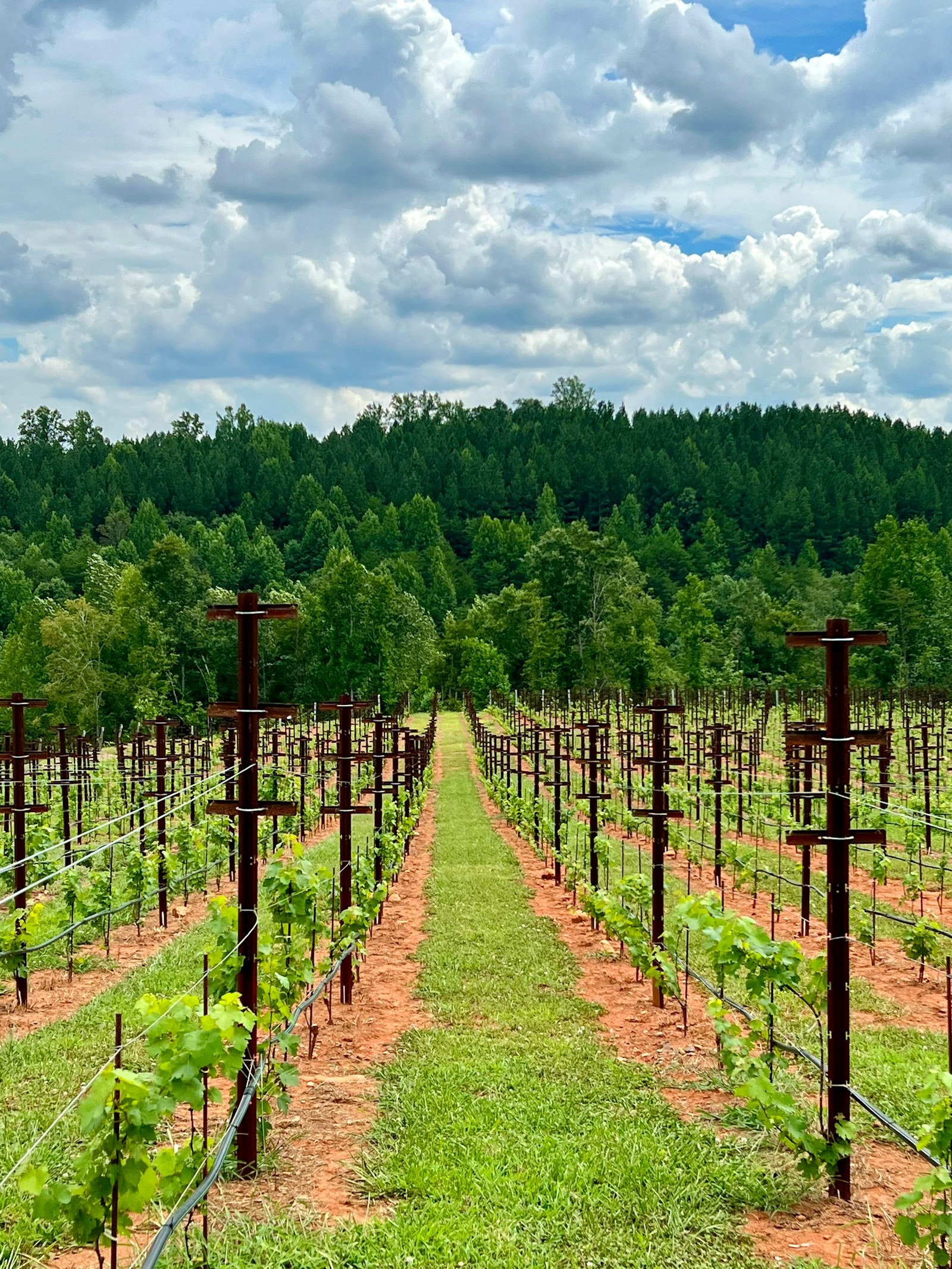
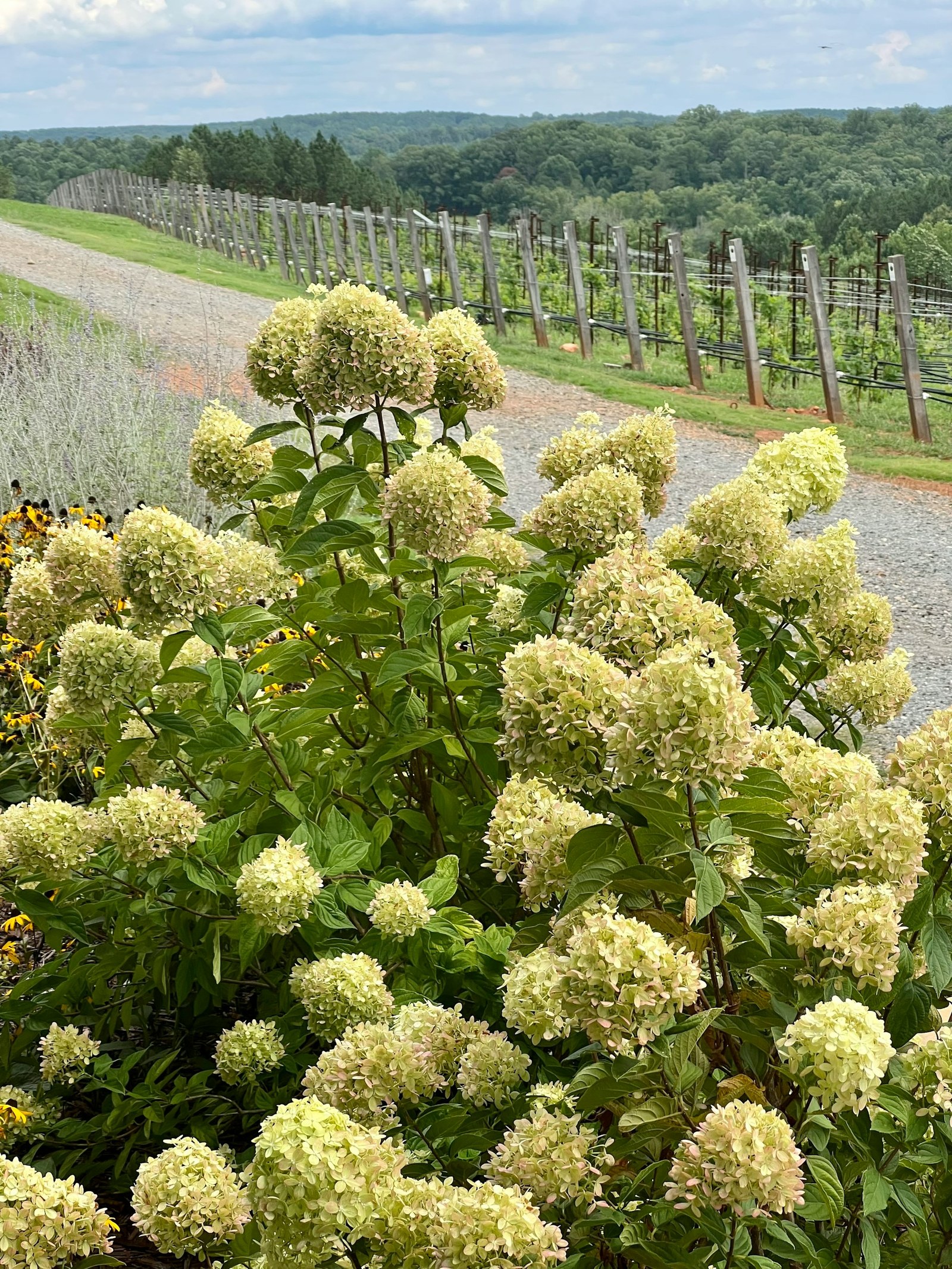
Young vines on red clay. The appellation is nine months old; some of the plantings inside it are more than twenty years older than that. Photograph by Stephanie Klepacki.
The Thread
A farmer described this in the 1850s. The federal government just built a boundary on it.
Here is the part that makes Tryon worth more than a tasting note.
A horticulturist from Franklin, in Macon County, named Silas McDowell spent his life watching something happen on these slopes and eventually gave it a name: the isothermal belt. On clear nights cold air, being heavier, slides downhill and pools in the valley bottoms. Warmer air is displaced upward and settles as a band across the mid-slopes. That band frosts later in the fall and earlier in the spring than the ridge above it or the bottom land below it.
NCpedia dates the coining of the term to 1858. The state's own Department of Natural and Cultural Resources points instead to his 1861 paper, "Theory of the Thermal Zone." Take your pick of the date. The observation is the same and it is the entire basis of the appellation.
When the TTB went looking for the feature that separates this ground from everything around it, the thermal belt is what it found. The agency put 95 percent of the AVA in Winkler Region V, the hottest classification on the scale, at an average elevation under a thousand feet in the Blue Ridge foothills. It then ran the western and northern boundary along the 1,200-foot contour line to catch the belt where it sits. A nineteenth-century farmer's field observation, converted into growing degree days and printed in the Federal Register.
One quirk of physics explains the wine, the horses, and half the relocation conversations in this county.
Because the belt does not only grow grapes. Mild winters are why year-round equestrian training works here, which is a large part of why the Tryon International Equestrian Center sits in Mill Spring rather than forty miles north. And it is what every buyer is describing, without the vocabulary, when they stand in a Polk County pasture and say the weather here is just easier than Asheville.
Tryon International sits at about 972 feet, below the contour, which means the venue that hosted the 2018 FEI World Equestrian Games is inside a federal wine appellation. As far as I can establish, that combination is unique in the Southeast.
I want to be careful with that claim, because the looser version of it is wrong and I tried hard to break it. A federal AVA sharing ground with a serious equestrian venue is not rare at all. The Virginia Horse Center in Lexington sits inside the Shenandoah Valley AVA. The Blowing Rock Charity Horse Show, running since 1923 and the oldest continuous outdoor horse show in America, sits inside the Appalachian High Country AVA, which is in this state. Middleburg, Virginia is hunt country with its own appellation and has been for over a decade. Anyone who tells you Polk County is the only place in the Southeast with wine and horses on the same dirt has not checked.
The narrow version survives. A World Equestrian Games host venue inside an AVA is, so far as the record shows, a Polk County exclusive. That is a smaller claim and it is the one that holds.
The honest footnote. NCpedia, the state's own encyclopedia, records that the isothermal belt has been "widely used and modified by scientists and area residents to sometimes exaggerate the advantages of the area." Land promoters have leaned on this phrase since the 1800s and some of their descendants sell real estate. The physics is real. The marketing built on top of it has not always been. Treat any claim that the thermal belt abolishes winter the way you would treat any other thing a seller tells you.
Inside the Boundary
Where to actually go
The federal rule counts four wineries inside the appellation. A fifth Polk County producer, Tryon Cellars, is listed by the state wine council but was not among the four counted in the federal petition, and it is flagged as such below. Call ahead on every one of them. Tasting room hours in a county this size move with the season and the harvest.
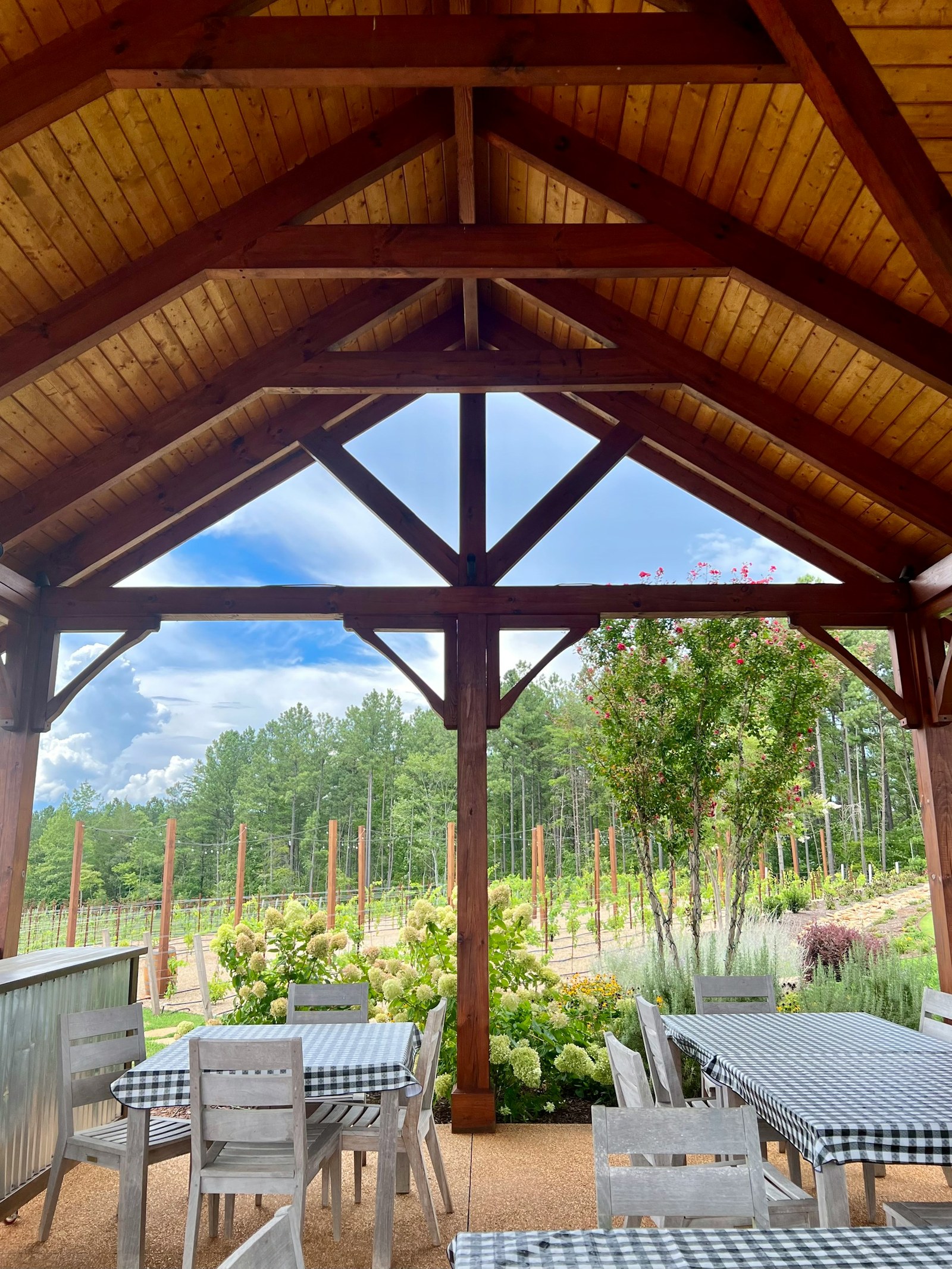
The tasting room in this appellation is usually a roof and a view. Photograph by Stephanie Klepacki.
Overmountain Vineyards
2012 Sandy Plains Road, Tryon, North Carolina · Winery
A 70-acre family farm with about 18 acres of grapes, which makes it the largest planting in the appellation and close to a quarter of everything growing inside the boundary. The land was bought in 1990, the first Cabernet went in around 2000, and the tasting room opened in 2010. The list runs Bordeaux: Cabernet Sauvignon, Cabernet Franc, Merlot, Petit Verdot, plus Petit Manseng, the variety that keeps appearing in this corner of the state because it holds acid through a long hot season.
If you make one stop, this is the one that shows you what the appellation is actually trying to be.
Mountain Brook Vineyards
731 Phillips Dairy Road, Tryon, North Carolina · Winery
A 75-acre farm with roughly seven acres under vine, first planted in 2002 and open to the public since 2013. Merlot, Petit Verdot, Cabernet Franc, Cabernet Sauvignon and Riesling. Twenty-three years of vine age inside a region that is nine months old on paper is the whole point: the appellation is new, the farming is not.
The oldest serious vines in the appellation, which is a different thing from the oldest business.
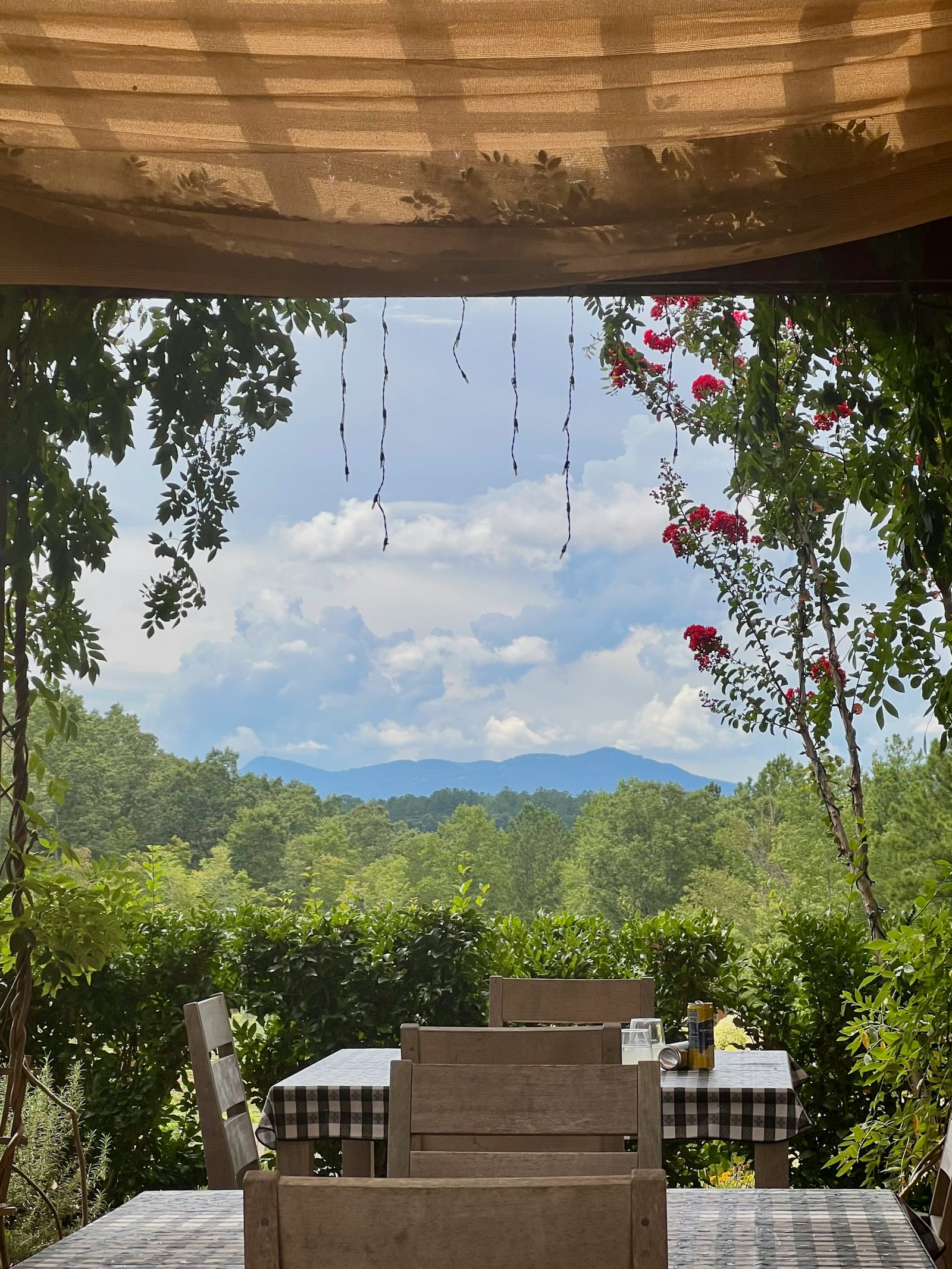
Mountain Brook Vineyards, Tryon. The crepe myrtle and the escarpment do most of the work. Photograph by Stephanie Klepacki.
Parker-Binns Vineyard
2275 Whiteside Road, Mill Spring, North Carolina · Winery
A 40-acre estate, and the address that matters most historically, because this is where the petition came from. Vineyard manager Cory J. Lillberg filed it on behalf of the county's growers. The planting is the broadest in the AVA: Chardonnay, Muscat, Petit Manseng, Chambourcin, Merlot, Cabernet Franc, Cabernet Sauvignon, Petit Verdot and Malbec. Mill Spring also puts you ten minutes from the equestrian center.
The farm that spent two decades getting the paperwork through. Go for that if nothing else.
Russian Chapel Hills Winery
2662 Green Creek Drive, Columbus, North Carolina · Winery
The oddball, and the county is better for it. Chardonnay, Sauvignon Blanc, rosé, Merlot and Cabernet alongside Muscadine, mead, and Kagor, a sweet Russian-style red you will not find on another tasting sheet for several hundred miles. Named for the chapel on the property. The land was Green Creek Vineyards before Andrey Medvedev bought it in 2009 and renamed it.
Call this one before you drive. The Tryon Wines trail publishes hours of Thursday and Friday 1 to 5, Saturday noon to 6, Sunday 1 to 6, and the state agriculture department named the winery as operating in November 2025. Yelp lists the business as closed. Those cannot both be current, and we would rather tell you the sources disagree than pick the one we like.
The one that proves a new appellation does not have to mean a uniform one.
Tryon Cellars
Tryon, North Carolina · Listed by the N.C. Wine and Grape Council, not among the four wineries counted in the federal petition
Working with Cynthiana off an estate vineyard. Cynthiana, sold elsewhere as Norton, is the American grape that carried commercial winemaking in this country before phylloxera and Prohibition took the industry apart. It was first identified near Richmond, Virginia in the 1830s, and its great commercial run happened in Missouri rather than the Carolinas. Planting it here is a historical argument as much as a viticultural one.
Nobody plants Cynthiana by accident. That choice is a statement about where American wine came from.
No ratings on this page. Southern Escapes Stars go on places I have actually sat in, and I have not run this corridor with a notebook yet. This is a guide, not a review. When I do it properly the scores will follow, and they will be mine.
Forty Minutes North
The Crest of the Blue Ridge
Point the car up US 176 through Saluda, which is worth the stop on its own and which sits at 2,168 feet in the gap between the two appellations, belonging to neither. About forty minutes from Tryon you reach Hendersonville and the ground has changed underneath you.
The Crest of the Blue Ridge Henderson County AVA took effect on August 19, 2019, covers 137,600 acres, and takes its name from the Eastern Continental Divide, which runs diagonally through it. Mean elevation is a shade under 2,362 feet.
That elevation is the whole difference. Tryon Foothills is Region V heat at a thousand feet. Henderson County is predominantly Region III, a cooler classification with a shorter season and the warm-day cool-night swing vinifera growers chase. Two appellations on one escarpment, arguing opposite cases, and you can taste both in an afternoon. That is not easy to do anywhere else in the Carolinas.
Henderson County was apple country for a century before it was wine country, and still is. The cider trail and the vineyard trail overlap, which gives the region a depth Tryon has not built yet.
Burntshirt Vineyards and Saint Paul Mountain Vineyards
Hendersonville · The anchors
The two producers the TTB named as the operating wineries when the appellation was granted in 2019. Both are the reference points for what Henderson County fruit does in the bottle.
Point Lookout Vineyards and Stone Ashe Vineyard
Hendersonville · The elevation play
Point Lookout sits at about 3,000 feet and runs World's Edge Meadery alongside the wine. Stone Ashe is on a bluff at roughly 2,700. These two make the altitude case most directly, and the views are not incidental to the visit.
Marked Tree, Sawyer Springs, Jeter Mountain, Johnson's Legacy and Appalachian Ridge
Flat Rock and Hendersonville · The rest of the trail
Marked Tree in Flat Rock sits at about 2,300 feet on an estate of roughly fifty acres with around seven under vine. Appalachian Ridge is the cidery, and skipping it because it is not wine misses what this county actually is. Souther Williams Vineyard, up in Fletcher, is usually listed with this group and is worth the drive, though on the published boundary it appears to sit just outside the AVA line in the Hoopers Creek valley.
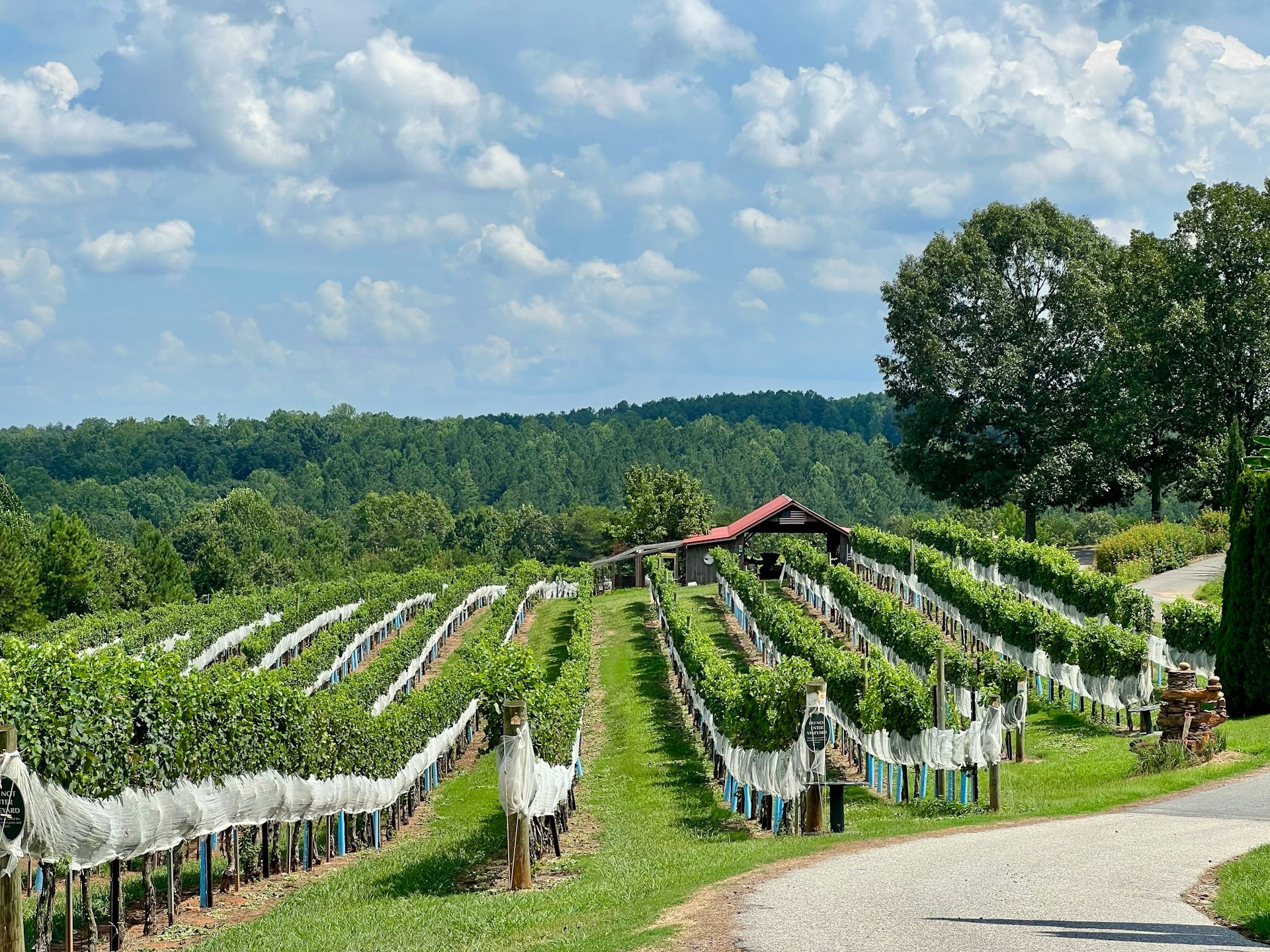
Netting goes on when the fruit turns and the birds work out what has happened. Photograph by Stephanie Klepacki.
Worth Knowing
The questions people actually ask
What does an AVA designation actually do?
It lets a producer put the region's name on the label. Nicole Chesney, marketing specialist at the state agriculture department and executive director of the N.C. Wine and Grape Council, put the mechanics plainly when Tryon's designation was announced: growers inside the boundary "may now label their wines as 'Tryon Foothills' as long as at least 85% of the grapes are grown within the AVA. It gives them a defined brand and provenance." It is a truth-in-labeling rule, not a quality rating. The TTB does not taste anything. It rules on whether a place is geographically distinct.
Is Tryon in the Crest of the Blue Ridge AVA?
No. They are two separate appellations in two adjoining counties. Crest of the Blue Ridge is Henderson County, effective August 2019. Tryon Foothills is Polk County, effective October 29, 2025. Their boundaries nearly meet at the county line, but they do not overlap and Tryon Foothills is not nested inside anything.
How many wineries are in the Tryon Foothills AVA?
Four, per the federal rule, across about 77.7 planted acres. The rule counts five commercial vineyards; the North Carolina Department of Agriculture counted twelve in November 2025. In a region this new the numbers have not fully settled.
What is the thermal belt, and is it real?
It is a temperature inversion. Cold air drains downhill overnight and pools in the valleys, leaving a warmer band across the mid-slopes that escapes frost longer at both ends of the season. Silas McDowell of Franklin named it the isothermal belt, dated by NCpedia to 1858 and by the state's cultural resources department to his 1861 paper. It is real enough that the federal government used it as the basis for drawing this appellation. It is also a phrase that has been stretched for promotional purposes for well over a century.
Can you do both wine regions in one weekend?
Comfortably. Tryon to Hendersonville is about forty minutes on US 176 through Saluda, or a little quicker on I-26. Tryon Foothills is four or five stops. Henderson County is ten. Two days is honest. One day is a highlight reel.
What else is in Polk County besides wine?
The Tryon International Equestrian Center in Mill Spring, which hosted the 2018 FEI World Equestrian Games and runs a national competition calendar. Downtown Tryon, a short walkable Trade Street, and the birthplace of Nina Simone, born Eunice Kathleen Waymon here in 1933. Pearson's Falls and Glen, kept by the Tryon Garden Club. Lake Lure and Chimney Rock are a short drive east.
The Market Read
What a federal label does to a rural county
Nothing, immediately. Nobody is repricing a farm because the TTB published a contour line, and any agent who tells you otherwise is selling.
What it does is slower and more durable. An appellation is permanent and it cannot be replicated. Another county can build an equestrian center. Another county can build a hotel, a distillery, a downtown, a golf course. Those are capital decisions and capital is patient. No county can grant itself an AVA, and this one's boundary is now fixed. Whatever recognition the label eventually carries accrues to a footprint that is closed.
It also gives a rural county a second reason to exist in a buyer's mind. Polk has been an equestrian story for forty years, and equestrian is a narrow market that buys for one reason and leaves for one reason. Wine is a wide one, and it overlaps with the horse audience less than you would guess. The same 176 square miles now carries two independent demand stories. Over ten years that is worth more than any single quarter's comparable sale.
What I am not going to do is put a per-acre number on it. There is no published closed-transaction land series for this corridor. The figures circulating online are asking prices from listing aggregators, and comparing an ask here against a closing in Wellington or Ocala produces a number that means nothing at all. When real data exists it will run in the Ledger with a source attached.
The move, if you are watching this corridor: the appellation is nine months old and consumer awareness is close to zero. That gap is the opportunity, and it will not stay open.