A 20,000-acre Montage sanctuary, the island's original resort, a car-free island reached only by ferry, and the private clubs where the golf runs from Nicklaus to Pete Dye.
The full guide, every community and its Southern Escapes Score, as a private PDF to keep, print, and mark up. Delivered by email.
Complimentary. Private list. Never resold. Skip the email, open the PDF.
The Lowcountry splits between Hilton Head Island, reached by a single main bridge, the Bluffton mainland, which avoids that bottleneck entirely, and Daufuskie Island, which has no bridge at all. All run hot and buggy June through September and shine in spring and fall, and all carry rising Beaufort County insurance costs, lower on the mainland than on the beachfront.
These six communities each own a clear story. One is the largest sanctuary on the map with a Montage. One is the island's original and still its most recognizable. One is a car-free island you reach only by boat. And three are private clubs where the differentiator is the golf, the harbour, or the river. Where a club publishes its initiation, we note it; where it does not, we say so.
A 20,000-acre Lowcountry sanctuary where a Forbes five-star resort, working stables, and three golf courses share more land than Manhattan.
Palmetto Bluff spans twenty thousand acres along the May River in Bluffton, organized into distinct villages and built in a deliberately anti-resort Lowcountry vernacular of moss, tidal creeks, and private docks. A Jack Nicklaus Signature course was joined in 2025 by a walkable Coore and Crenshaw layout, with a third course planned, and the Montage Palmetto Bluff anchors a spa, restaurants, and Longfield Stables. Residents kayak and fish off the dock with the same ease others play golf.
Entry starts around $1.3M, with a median near $2.75M and the high end into the teens. The club raised its top golf initiation to $300,000 in 2025, a deliberate barrier, and the median has eased about twelve percent off the peak. There is no beach; it is river and marsh, thirty to forty minutes from the Hilton Head sand. For a buyer who wants land, nature, and a five-star layer with no bridge bottleneck, nothing in the Lowcountry matches the scope.
May River tide math: golf at the top of the morning, sandbar at the bottom of the tide.
The May River course, Jack Nicklaus on Paspalum, before the heat; or Crossroads, the King-Collins nine with forty-foot dunes, when the day wants match play.
The May River sandbar emerges at low tide and the village empties onto it. May River Excursions runs from the Bluffton town dock if the boat is still on order.
Old Town Bluffton: the Church of the Cross on the bluff, the Calhoun Street galleries, Corner Perk roasting its own.
River House at Montage over the May River, twenty-five-hundred labels deep, or FARM and The Pearl in Old Town for the off-property nights.
Buffalos' brunch in Wilson Village, new oyster bar included, then a kayak on the river while the tide does the work.
Hilton Head's original masterplan and still its most recognizable address, where the PGA Tour plays every spring.
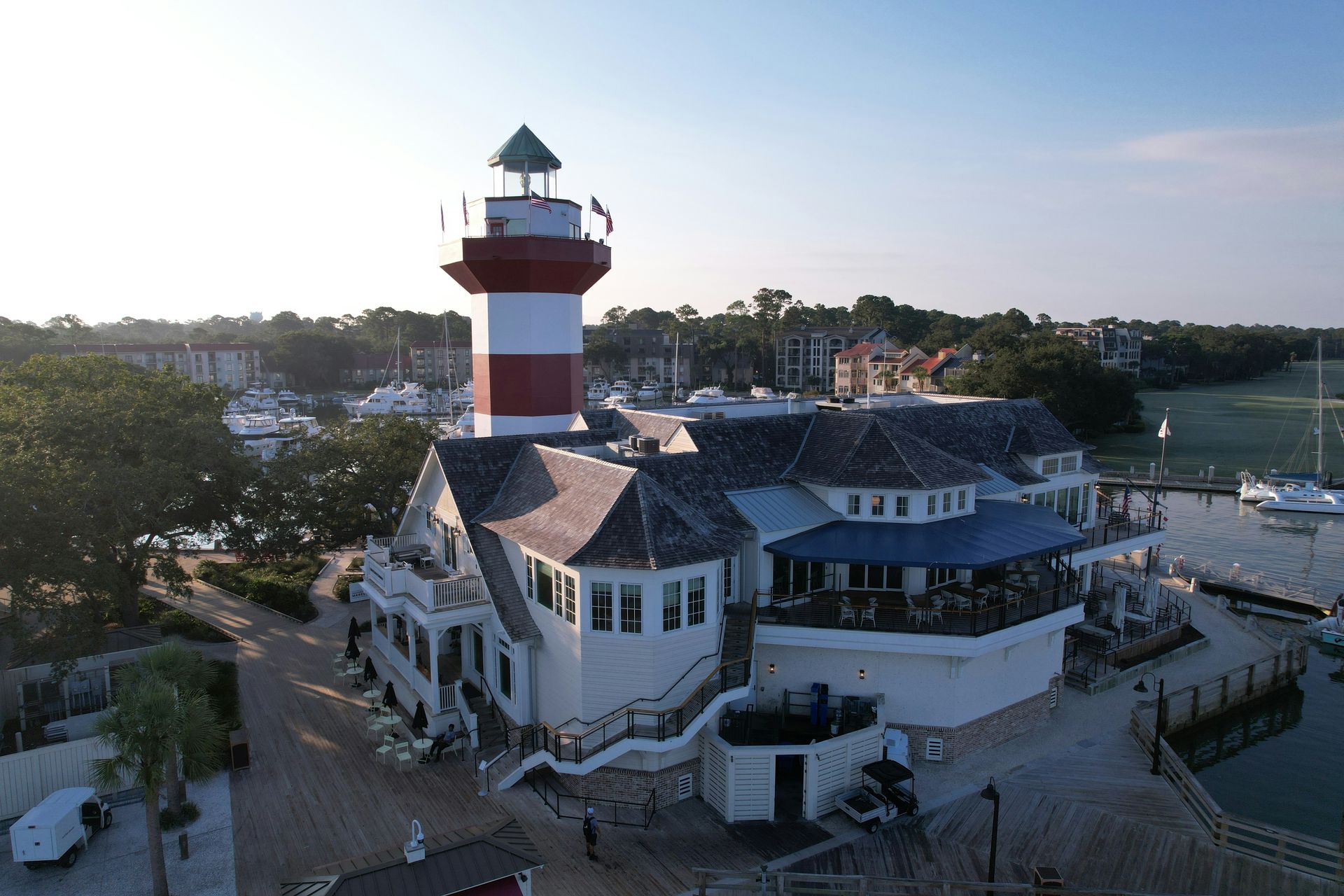
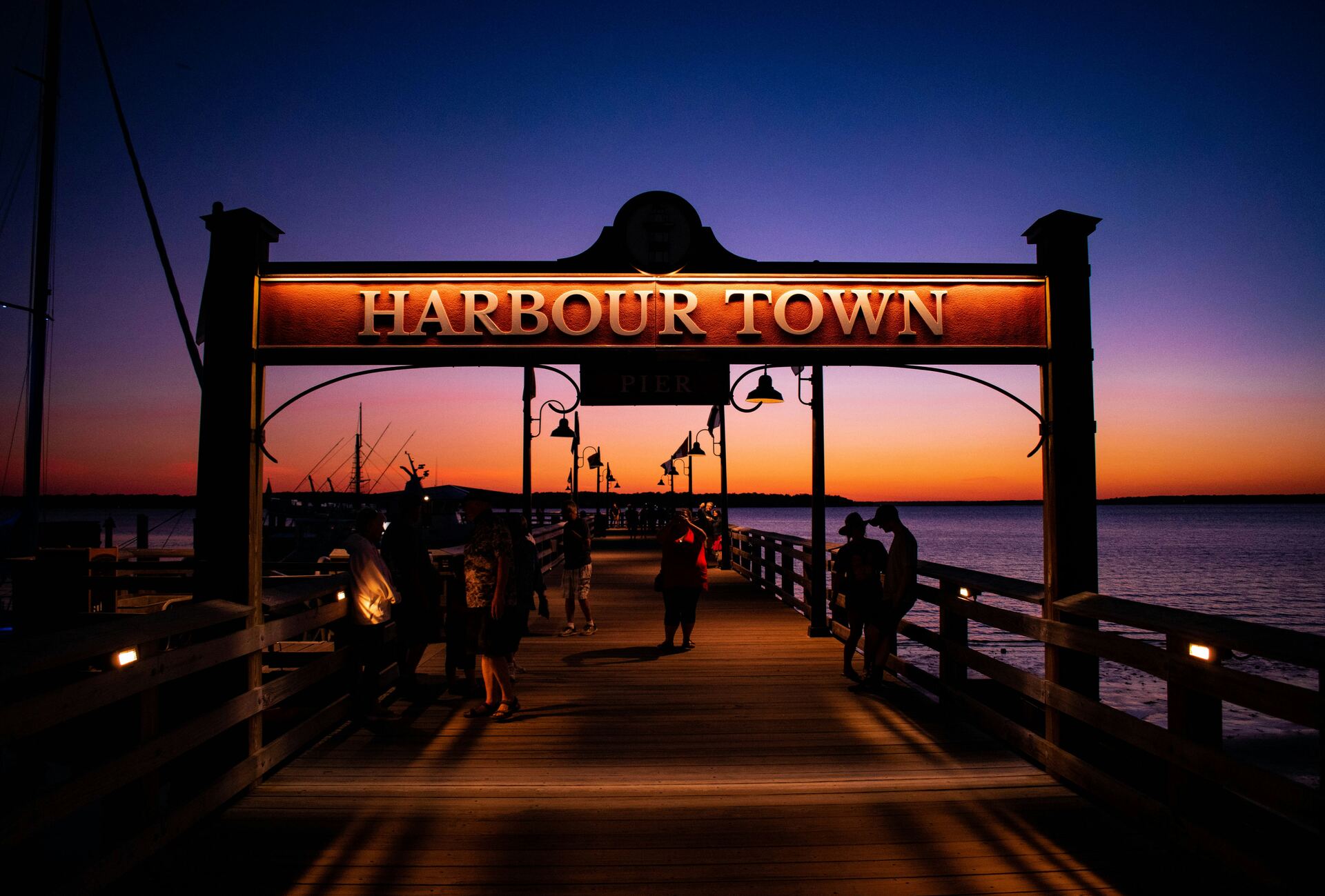
Sea Pines, developed starting in 1956, is the island landmark: five miles of private beach, more than twenty miles of leisure trails, and Harbour Town with its candy-striped lighthouse and yacht basin, arguably the most photographed scene in the state. Three Pete Dye courses, led by Harbour Town Golf Links and its annual RBC Heritage PGA Tour stop, give it a pedigree newer communities cannot manufacture, and its scale means everything from beachfront estates to golf cottages lives inside one gate.
Entry runs from around $500K for older villas, with a median near $905K and a luxury tier from $2M into the teens, and an unusually low HOA. The catch is that it is not fully private: day-pass visitors and a heavy rental presence dilute the exclusivity, and the single island bridge means real summer traffic. Club membership is optional, a meaningful cost flexibility. For name recognition and beach access in one address, Sea Pines is the benchmark.
The lighthouse, the Heritage, and a rebuilt Quarterdeck with a rooftop raw bar.
Harbour Town Golf Links, home of April's RBC Heritage; play the eighteenth toward the lighthouse and forgive yourself the sound-side wind.
Lawton Stables for a ride through the Sea Pines Forest Preserve, or miles of bike-hard beach from the beach club.
The new Quarterdeck under the lighthouse, rebuilt two stories tall with a rooftop oyster bar and 270 degrees of Calibogue Sound. Links, in the clubhouse, holds the steak-and-brunch flank.
Salty Dog Cafe at South Beach Marina, because some rituals are load-bearing with children aboard.
Coffee in Harbour Town watching the yachts sort themselves out, then a last walk on the preserve trails before the gate.
The Lowcountry's only car-free island address: no bridge, no public roads, reached by private ferry, where you trade the car for a golf cart at the dock.
Haig Point occupies the northern tip of Daufuskie Island, in Calibogue Sound between Hilton Head and Savannah, reachable only by the community's own private ferry. Fewer than three hundred homes sit across roughly one thousand acres, golf carts are the only vehicles, and the restored 1873 lighthouse anchors a property layered with Gullah Geechee heritage that gives Daufuskie a cultural depth the resort islands cannot manufacture. Days run to fishing and crabbing the Sound, riding at the equestrian center, and watching the sun set behind Harbour Town's lighthouse across the water.
A Rees Jones Signature course has earned national top-100 recognition, paired with an equestrian center, a deepwater marina, and a tennis program, and a member-approved investment of more than $40 million is upgrading the golf and amenities through 2029. Homes run from roughly $400K into the low seven figures, with interior lots that are inexpensive by luxury standards. The honest trade is the water: ferry dependence is total, and groceries, contractors, and even hurricane evacuation cross by boat, which is why the club stood up its own barge company to handle construction. For a buyer who treats the ferry as the price of genuine seclusion, nothing in the Lowcountry is more private.
The ferry is the front gate, and the island keeps its own time.
Cross on the club's private ferry, coffee on the top deck, Calibogue Sound doing its best impression of a commute.
Twenty-nine holes of Rees Jones, including the Signature course that launched his solo career. A phased renovation begins late 2026, so play greedily now.
Golf-cart touring is the local locomotion: the 1883 Bloody Point Lighthouse and its museum, Gullah history markers, sandy lanes under the oaks.
Club dining on property; for the counter-culture lunch, Old Daufuskie Crab Company at Freeport Marina, deviled crab and live music included.
The beach with nobody on it, then the late ferry back while the sound goes gold. The inconvenience is the moat, and the moat is the point.
The only Lowcountry club where Nicklaus and Pete Dye built on the same property, with seven miles of shoreline and a nature preserve next door.
Colleton River occupies one of the most dramatic sites in the Lowcountry, a fifteen-hundred-acre peninsula in Bluffton bounded by river and marsh, with a twelve-hundred-acre nature preserve forming a permanent buffer. Its calling card is golf: a Jack Nicklaus Signature course and a Pete Dye Signature course on the same property, one of the rarest dual-designer pairings in private-club America, plus a par-three course and deepwater dock access to the Intracoastal. Roughly five hundred twenty-five custom homes on large lots keep density low.
Lots start near $350K and the median sits around $2.15M. Membership is published and serious: a $125,000 full initiation with annual dues near $30,000, the steepest in the region, which buys deliberate scarcity. There is no beach, and the social scene is quieter than Palmetto Bluff. For a serious golfer who wants two elite, distinct courses on the mainland with no bridge risk, this is the strongest pure-golf address on the map.
Nicklaus and Dye on one point of land, with Port Royal Sound as the third architect.
The Nicklaus course first, then the Dye links along the sound in the afternoon wind: one of only three American clubs holding signature designs from both.
The Borland par-three six, drinks allowed, handicaps suspended.
The community fronts Port Royal Sound and the Colleton River; charters run from the Bluffton town dock ten minutes away.
Old Town Bluffton at night: The Pearl on Calhoun Street for coastal fine dining, FARM for the field-to-table Sunday brunch.
Corner Perk for the roast, the Church of the Cross for the bluff view, and the causeway home before the beach traffic thinks about it.
Hilton Head's most members-only club, a top-100 Pete Dye course owned outright by the people who play it.
Long Cove sits on about six hundred acres on the island's south end, organized entirely around a Pete Dye course that has held a place among America's top hundred private layouts for three decades. Membership is mandatory and member-owned: no developer, no outside management, every owner a member, which makes for unusually tight social cohesion. Tennis, a pool, fitness, marina access, and clubhouse dining are all included in one annual figure with no outside play on the course.
The median runs near $1.43M, with the strongest appreciation of these five communities, and the initiation recently stepped up to $75,000 with all-in annual dues near $21,000, a single predictable number that covers everything. There is no beach access from within the gate, and the community is small enough that amenity variety is limited. For a serious golfer who wants a top-100 course with zero resort traffic and a member-owned structure, it is a tight, appreciating market.
The Dye purist's address, mid-island, with Broad Creek off the back porch.
The Pete Dye course, a top-100 fixture restored by Bobby Weed, walking with the early group before the island wakes.
Broad Creek from the community dock: kayaks at slack tide, dolphins on patrol, the marsh doing its evening colors.
Salty Dog at South Beach, or Skull Creek Boathouse for the sunset raw bar the whole island respects.
Skull Creek's dock tables at golden hour, or the club's own dining room among people who moved here for the same course you did.
South-end beaches via Coligny, a dolphin cruise if the grandchildren demand it, then nine more holes because the course is the amenity.
Hilton Head's most unusual address, built around one of only three lock-controlled deepwater harbours on the East Coast.
Wexford's five hundred twenty-five acres center on a thirty-seven-acre inland harbour held at a constant eight-foot depth by a lock system, so members berth boats up to sixty-five feet regardless of the tide, a genuine rarity on the East Coast. An Arnold Palmer Signature course, tennis, and a nautical-themed clubhouse round it out, and a no-rental policy with mandatory membership keeps it owner-occupied and consistent.
Townhomes start near $900K, golf-course homes run $1.5M to $2.5M, and the median sits around $3.1M with strong recent appreciation. The structure is a $70,000 initiation on a home purchase plus mandatory annual assessments near $20,000. There is no beach inside the gate and the Palmer course sits a tier below the Dye and Nicklaus layouts nearby. For a boater who wants tide-proof deepwater access on the island with no rental churn, the lock harbour is the whole argument.
The harbour with a lock on it: eight feet of water at every tide, and the boat behind the house.
Cast off from your own slip: Wexford's lock-controlled harbour, one of three on the East Coast, holds eight feet regardless of tide. Calibogue Sound is the backyard.
The Arnold Palmer Signature redesign, with its Road, Redan, and Biarritz nods for the architecture literate.
Shelter Cove's shops and marina five minutes north, or Coligny Beach with the umbrella brigade.
The clubhouse dining room, or Skull Creek Boathouse for the sunset raw bar the whole island respects.
A dolphin tour out of the south end, brunch at Links in Harbour Town, and back through the lock before cocktail hour, which is the whole argument for the lock.
The weekly letter behind these scores: the markets, the residences, and the slower returns of moving to the Southeast. Three minutes, read with a coffee.
Welcome aboard. Check your inbox for the welcome note; the next letter lands soon.
Complimentary. Unsubscribe in a click. We do not share the list.
Before you tour a single home, an Advisory Conversation tells you which of these communities actually fits the life you are trying to build, and what the move is worth under the new Carolina tax math.